
By AJ Schultz, Editor, and Whalesong Staff Writers Jasz Garrett, Grace Igel, and Alyson Kenney.
Originally Published on Feb. 15, 2024. Displayed publication date was changed on Mar. 18 to follow Chancellor Palmer’s response letter on the homepage.
Content Warning: This editorial contains mentions of rape, sexual assault, domestic abuse, sexual harassment, and systemic injustice. AWARE provides free, confidential resources for victims in Alaska.
A rot has festered at the heart of this University for over a decade. Keep your ears open, and you’ll find a majority have either been failed or knows someone who’s been failed by Title IX, the federal law that supposedly prohibits domestic and sexual violence at federal institutions.
Last fall, a close friend of mine chose to stay safe by dropping out of UAS.
They were in a dangerous living situation. UAS Housing recommended they fly home temporarily while UAS took care of the issue.
That advice was misguided, as Housing found it could not expel, evict, or otherwise impose sanctions on the aggressor without first going through the Office of Equity and Compliance (OEC), the Title IX process.
The process takes months, and classes were already underway. The student could not afford to wait it out as the deadline to drop classes was fast approaching.
So, they were forced to decide between ensuring their safety at home or returning to UAS, where they didn’t feel safe, and go through the process.
It was the responsible decision to give up their life in Juneau.
UA’s Troubled History
In 2017, the UA system was the subject of a routine investigation by the United States Department of Education’s Office of Civil Rights (OCR). It found Title IX failures at all three major University campuses: Anchorage, Fairbanks, and Juneau.
Without identifying the campus, an OCR letter cited more than 20 cases across the UA system as examples of failure.
One case, involving a student who had been sexually assaulted by a soldier, was left in the hands of Residence Life. UA did not conduct an investigation, or offer the student any interim measures. Instead, the student was disciplined for underage drinking.
When a student reported in 2012 that a professor had sexually harassed at least four students, an investigation report was drafted but never completed. No action was taken.
After the investigation, the University of Alaska entered a voluntary resolution agreement (VRA) with OCR to improve safety on its campuses. Importantly, this VRA is the reason each campus has a dedicated Title IX office. UAS Vice Chancellor Lori Klein was appointed the first UAS Title IX coordinator.

“There was a lot of pressure on the entire University system at that time to be responsive to this voluntary resolution agreement,” Klein said. “It wasn’t forced on us by the Office of Civil Rights. We entered into it as a University of Alaska system with a commitment to do better under Title IX.”
The OCR stipulated that the University system had to meet the VRA conditions, or judicial action would be taken against it. Refusing to enter the agreement was not a practical option for UA.
Klein said the University met the VRA goals and that work lives on across the UA system. While these changes were a step in the right direction, Title IX issues still exist at UA.
UAS, After the VRA
For a long time, resentment toward Title IX at UAS was expressed through a network of whispers. Friends confided in friends; incidents became rumors as frustration grew and confidentiality stood in the way of public outcry.
In a written interview with Whalesong, UAS Student Pigeon Kearney said Title IX is so ineffective that the burden falls on students to hold each other accountable.
“The one ‘positive’ about the backward system is the sense of community that comes from it,” Kearney said, “and the notion that abusers will never be safe from the truth on campus, no matter what the University dictates.”
These sentiments are shared by many at UAS. From December to February, Whalesong surveyed UAS students across all three campuses through google forms. We received 53 responses, with as many as 26 providing written statements. Respondents detailed the ways they felt Title IX has failed the UAS community.
Less than half of respondents agreed they felt safe from violence and discrimination on campus. Over seventy-one percent said they were not confident in the Title IX office to take fair and timely action.
According to UA’s mandatory Title IX training, victims have the right to a prompt investigation and grievance process, as well as regular updates from the Title IX office. One student respondent said their report, which was made in October 2019, was not resolved until January 2021.
“By this time, I was no longer a student of the UA system or a resident of the state of Alaska. The perpetrator, who had been found guilty, had received his degree. The only punishment would be that he would not be allowed to attend classes through UAS for 2 years.”
Another said a rape case they reported in the spring of 2023 was not followed up on until late summer. The respondent said the office did not communicate crucial trial information to them or the victim. At the time, Ryan Wark was UAS Title IX coordinator and transferring to a statewide Title IX position in Anchorage.
Other survey respondents called the process “exploitative, abusive, and traumatizing” for victims, and said there were “more risks than benefits” to filing a report.
“It’s so unorganized and stressful,” one student said. “It’s almost not worth the trouble to go through all of that and have nothing happen.”
A disturbing and damning pattern emerged among the testimonies. Multiple students complained that Title IX offenders were not only getting away with harassment and violence with a slap on the wrist, but that these offenders kept their jobs at the University.
“UAS continues to employ students who have harassed numerous people in positions that are unavoidable, such as housing or the cafeteria,” one response said.
Fruechtnicht’s Post
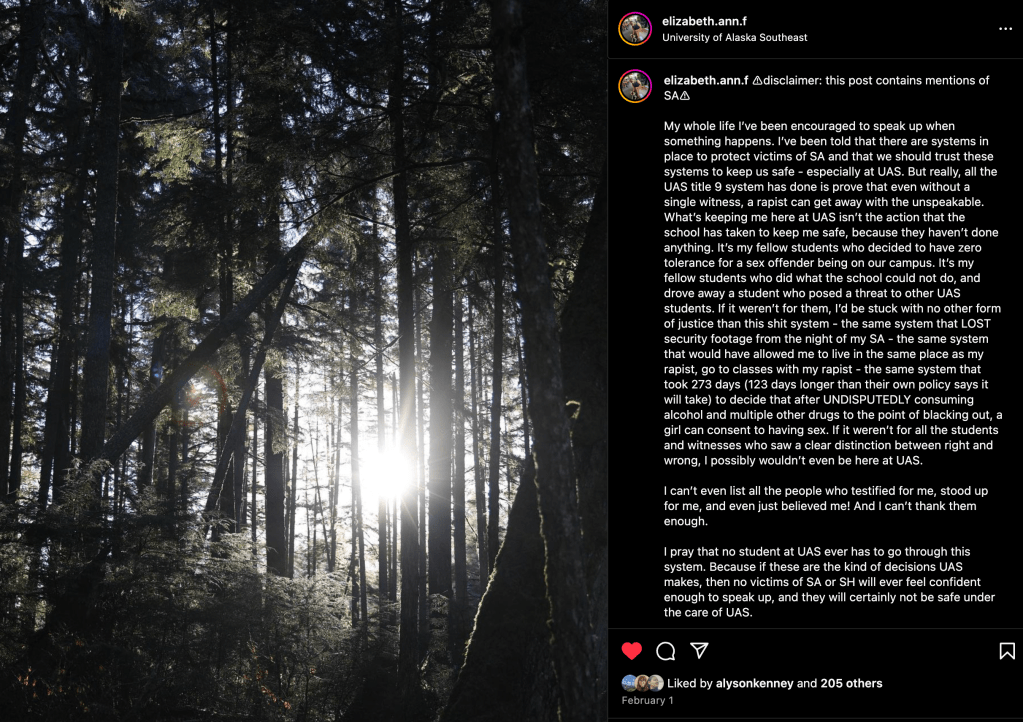
On Feb. 1, Liz Fruechtnicht, a student and University employee, spoke out publicly over Instagram about how Title IX failed her.
“I’ve been told that there are systems in place to protect victims of SA [sexual assault], and that we should trust these systems to keep us safe- especially at UAS,” the post read. “But really, all the UAS Title IX system has done is prove that even without a single witness, a rapist can get away with the unspeakable.”
According to Fruechtnicht, her case ended with the defense being found innocent despite no witnesses defending them, and several testifying for her.
In Title IX cases, the final verdict is made by the Alaska Office of Administrative Hearings (OAH), not UAS. But many of Fruechtnicht’s complaints apply at the University level.
In addition to UAS Housing allegedly “losing” security footage from the night of the incident, Fruechtnicht said her grievance process took 123 days longer than the timeframe given to her by UA. Throughout the process, she and others involved said communication was sparse, vague, and unreliable.
As Kearney observed, a sense of community comes from students holding each other accountable. Fruechtnicht said justice was served by her fellow students who drove her abuser away from campus.
“If it weren’t for them,” she said. “I’d be stuck with no other form of justice than this s- – – system.”
Fruechtnicht’s post was a dam-breaker, unleashing a barrage of cross-posts from fellow students showing their support and sharing their own stories. The post garnered more than 200 likes and reached over 900 accounts; on a campus as small as UAS, it could not be ignored.
In response, Title IX coordinator Mitzi Anderson said she was proud to be on a campus where students felt empowered to speak up when a system was failing them.
“I recognize my role within that system – both the power and the limitations that come with it,” Anderson said. “I will do everything I can to support a fair Title IX framework at our University.”
UAS appointed Anderson as on-campus Title IX Coordinator in October 2023.
Anderson is no stranger to systemic change; in her prior experience as a civil rights investigator, she said her most rewarding cases eventually led to broad reform.
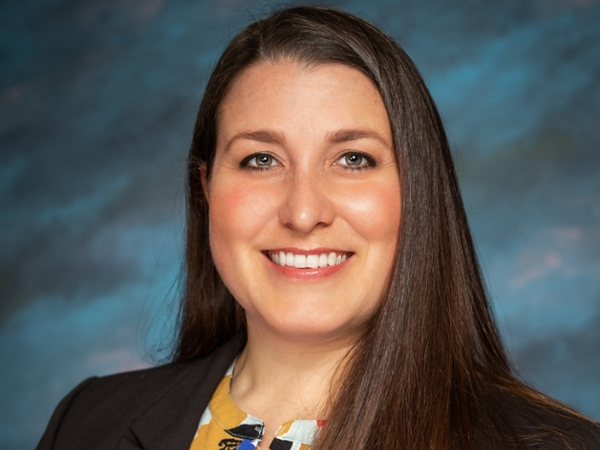
UAS Chancellor Aparna Palmer, who began her tenure in July 2023, said she understands why students don’t trust the system, and her goal is building that trust.
“To the students, I would say give us a chance,” Palmer said. “Because we want to do right by you.”
The Listening Session
Anderson held a listening session on Feb. 12, where students lambasted the Title IX process and demanded systemic reform. Twenty-two students were in attendance, seven over zoom. Chancellor Palmer was absent, and apologized in an email the following day, stating plans to attend future sessions.
Students pleaded for Anderson to advocate for the student body by making a statement with the Chancellor to the UA Board of Regents. Statements like this are typically presented by the Chancellor to BOR. While Anderson agreed that this burden should not be on students, she said student testimonies are often more powerful.
UAS student and Whalesong reporter Alyson Kenney suggested faculty and students undergo more serious Title IX training.
UAS student Sophia Gimm said the campus is in need of on-site police or security who can respond to urgent calls. She said she was told to call JPD in the event of an incident at student housing.
“Yeah, the obvious answer is ‘call the police,’” Gimm said, “but there should be something on campus for that. There should be someone that’s able to respond immediately.”
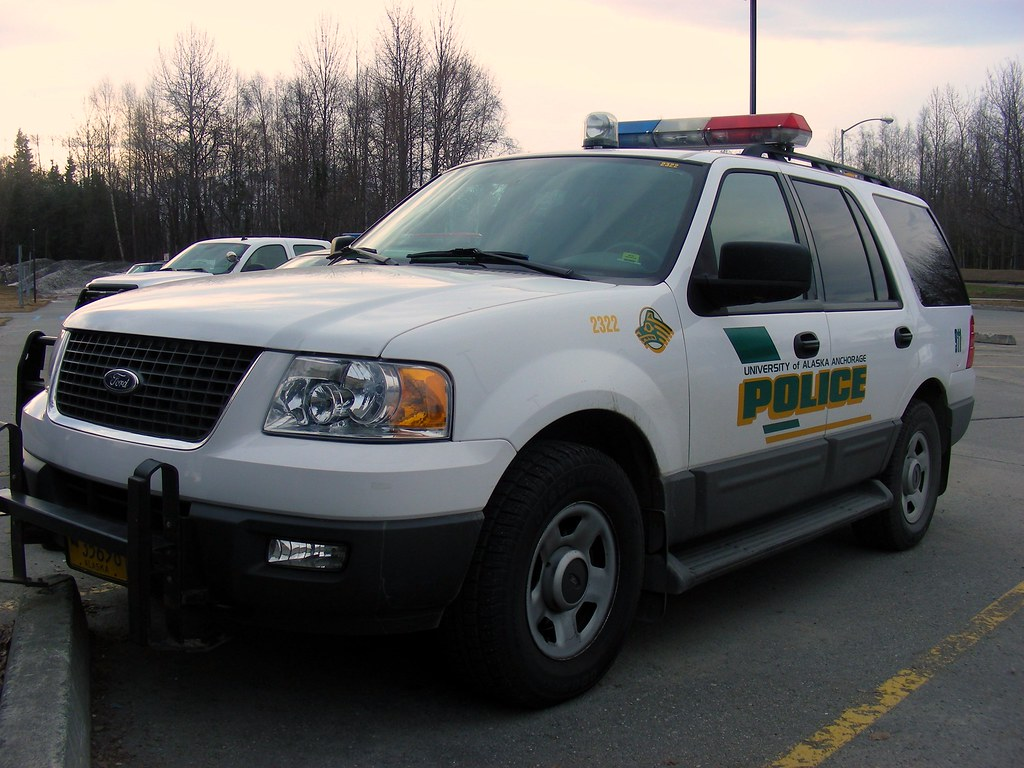
Grievances with Student Housing were a recurring pattern during the listening session.
Some students wanted Anderson to take their complaints directly to Housing and pressure them to do better.
A common sentiment among students was that during the Title IX process, the victim makes all the sacrifices.
“Once you make that initial report, it shouldn’t be so hard,” UAS Student Hannah Sallee said. “It should start getting easier for you.”
“When I first came to UAS, I felt like I finally found somewhere that I belonged,” Sallee said, “and I just don’t feel supported or safe here anymore. My experience at UAS, since having to interact with the Title IX office, has changed a lot. I know other people feel that way, too.”
Sallee added that her friend, who had to leave UAS due to Title IX problems, was a great asset to the University, and she was sad to see the University not fight for him.
“You realize all these people, who are supposed to be protecting you, are really protecting each other,” she said.

Several students said having only one employee oversee Title IX is not nearly enough. A UAS deputy Title IX administrator will be hired, Anderson said, but will work from Anchorage. When asked why an in-person deputy could not be in Juneau, she said housing was an obstacle.
In a Dec. 6 Whalesong interview, Chancellor Palmer acknowledged that Anderson’s job is very difficult. “It takes so much emotional and intellectual strength to do that,” she said. “You can be worn down really easily.”
This is not lost on students. One survey respondent said Title IX, like all of UAS, is understaffed and overworked, with “way too much compliance responsibility placed on one employee.”
Anderson said she plans to hold the next listening session at a UAS housing facility, hopefully within a month. Students insisted that staff and faculty, who were told the Feb. 12 event was student-only, ought to be a part of future sessions.
The problems at the heart of UA’s Title IX system predate Anderson’s arrival, and go all the way to the Oval Office.
Title IX and the Political Machine
“One of the challenges with Title IX policy is that it changes with the administration in the White House,” Vice Chancellor Lori Klein said. “We have to follow the guidance and regulation we get from the federal government.”
Every presidential administration puts out guidance and regulations on how to enforce Title IX. On May 6, 2020, the Trump administration released its two-thousand page long list of regulations.

In former President Donald Trump’s regulations, sexual harassment is redefined as “severe, pervasive, and objectively offensive” actions. This drastically narrowed the scope of what universities were allowed to investigate, since “offensive” is a hard condition to prove.
Even if an offense managed to meet the criteria for harassment, there were still barriers put in place which prevented universities and Title IX offices from intervening.
“When you’re a compliance coordinator, you have to follow the guidance given to you,” Klein said, “and if the guidance given to you is unclear, if it’s not transparent, if it’s confusing, if it’s nonexistent, it makes your work so much harder.”
Trump’s rule also made the grievance process more difficult for survivors, requiring cross-examination where a victim must face their aggressor directly.
The only other option would be an “informal resolution,” which is the equivalent of having the abuser “shake on it” with the abused. What’s more, abusers can refuse this, and then the case dies cold.
So if something happens to you, your options are to stay quiet or derail your entire life with a drawn-out process with the cards stacked against you. We’ve seen this at UAS. Our university is not alone in this problem.
Title IX can only do so much when violence itself is redefined to protect the violent.
These rules are on their way out, but they’re stuck in the doorway. President Joe Biden’s administration has been struggling to instate its new Title IX regulations for almost three years. Universities across America are still operating under Trump-era Title IX regulations.

Biden’s proposed policies would break down the obstacles built by Trump, and streamline the grievance process for victims while ensuring an equitable process for all parties.
“Our proposed changes would fully protect students from all forms of sex discrimination,” Education Secretary Miguel Cardona told NBC News on June 23, 2023. “Those protections include discrimination based on sexual orientation and gender identity.”
But the Biden changes may not go into effect until as late as August.
Anderson is part of the Association of Title IX Administrators (ATIXA). She said coordinators nationwide are frustrated about the lack of progress.
So, what can UAS do? What’s the call to action here? A small college in the middle of an Alaska rainforest can’t do much about governmental incompetence.
Well, according to a TIME article by Nicole Bedera, the rules made under Trump’s administration are guidelines for compliance offices, not hard-and-fast requirements.
“Universities have the right to take a more proactive approach to address sexual violence,” Bedera writes, “but there will be no federal oversight. What we are most likely to see in the years to come is that some schools—likely the wealthiest and best resourced schools—will continue to support survivors beyond the letter of law, while others will do the bare minimum.”
Though UAS is far from wealthy or well-resourced, this does not mean we can only do the bare minimum. Title IX must be prioritized for victims who cannot wait for presidential transitions.
The Future
UAS must take initiative on the state level. All three colleges in the UA network were implicated in 2017– all three must act together to finally mend this wound.
UAS can break the silence, and Chancellor Palmer can make a statement to the Board of Regents, to UA President Pat Pitney, to the office of the Governor, to the White House. Make our struggles known. Advocate publicly for the student body; if UAS is truly powerless to solve these issues itself, then it needs to take it up with the bosses.
UAS must re-evaluate its distribution of labor, and establish a more robust staff to oversee Title IX under Anderson’s direction. This means in-person staff; not remote workers. Relegating jobs this important to Zoom and Gmail tells the UAS community that our campus is not taken seriously.
There must be real, effective campus security instituted at UAS, so students feel protected and have a figure of authority to report to in emergencies.
JPD once had an on-campus office, used occasionally. It has since been repurposed and is now the Whalesong office.
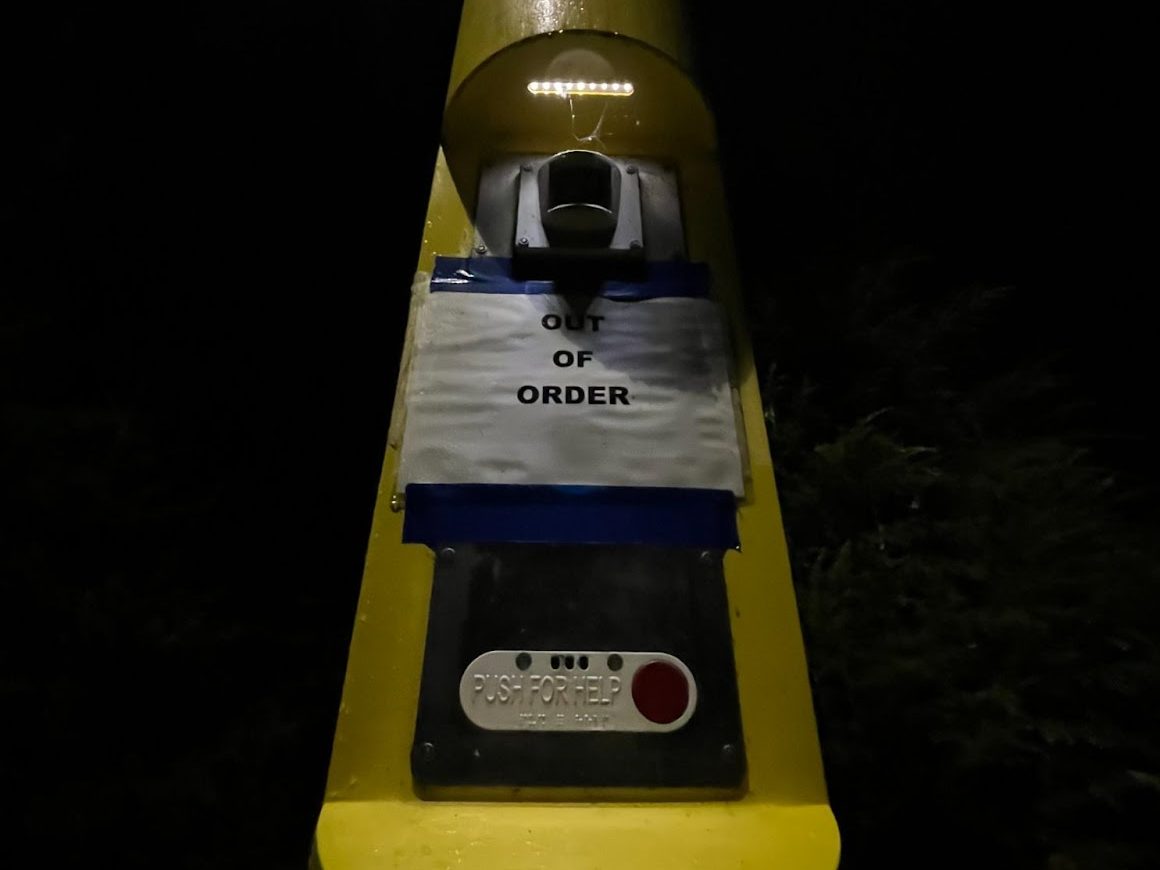
At the very least, UAS could fix those “push for help” posts on the trail behind upper housing, one of which has been out of order for several years.
UA must strengthen its efforts to educate people on Title IX. Instead of requiring that all students click through a slideshow of legal jargon and sugar coated PR copywriting, hold an in-person training.
Engage people at the face-to-face level. Make it known to all students, especially students at an increased risk for violence, that UA takes Title IX seriously enough to go above and beyond a rudimentary, 30-minute online course.
The UA Board of Regents is holding public testimony on Tuesday, Feb. 20, from 4 – 5 p.m. Whalesong encourages everyone who attended the listening session to call in and testify on behalf of the student body that our Title IX system is in crisis and our campuses desperately need support.
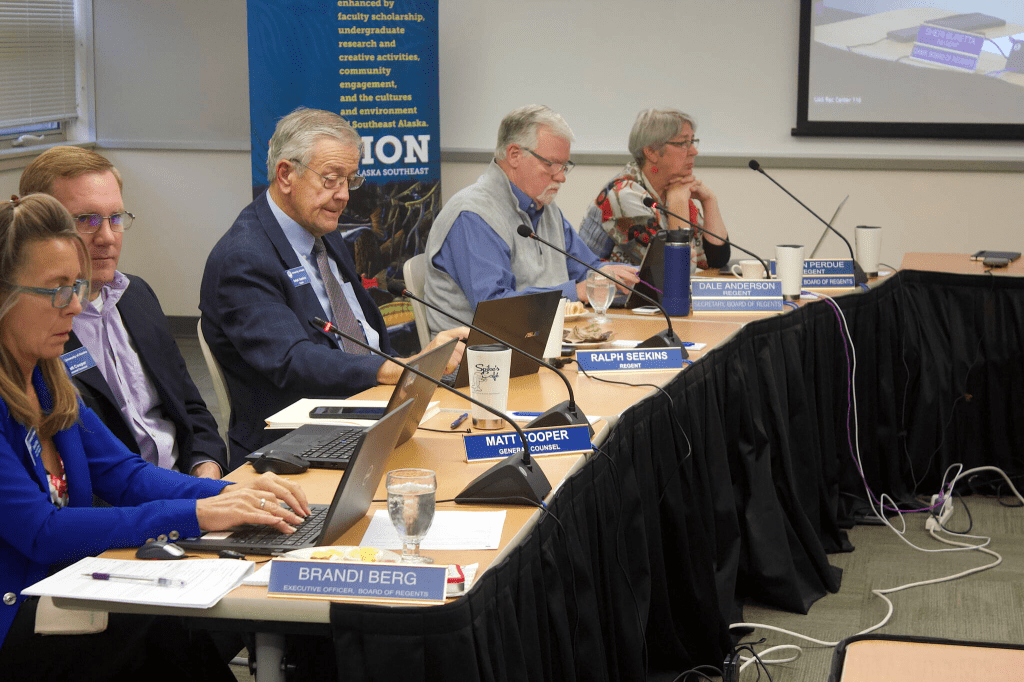
Whalesong speaks for all UAS students when we say this should not be our problem. We pay tuition. We pay fees. We pay for housing and food. Much of the university budget is covered by students, so a safe campus that doesn’t enable violence should not be too much to ask for.
The UA system, including UAS, must do better. With the guidance of Anderson and Palmer, there is reason for optimism. As a community, we must hold them to their word.
–
A Whalesong Editorial
by AJ Schultz and Whalesong Staff Writers Jasz Garrett, Grace Igel, and Alyson Kenney.


 WHALESONG
Leave a reply to University of Alaska students in Juneau raise alarm over campus response to sexual assault – UpNitro Cancel reply