By Ellie Ruel
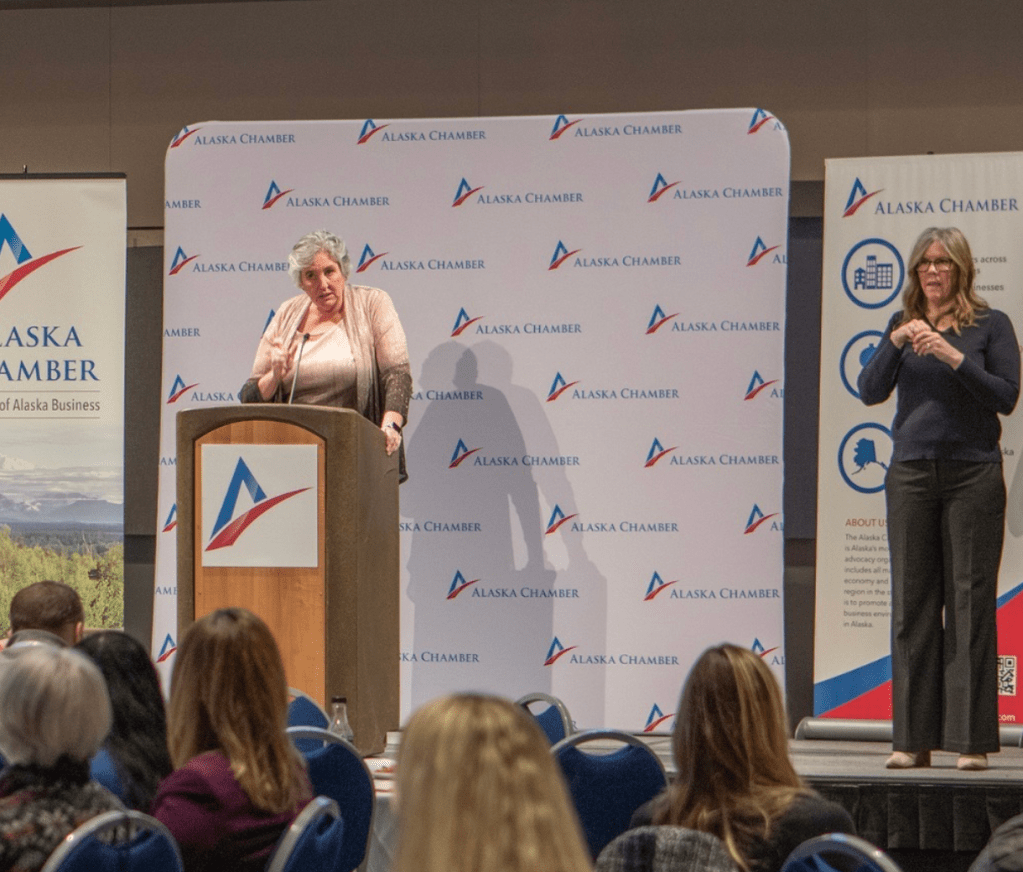
(Photo Credit: @ua.system on Instagram)
UA President Pat Pitney announced plans to improve retention, grow enrollment, and speed graduation times during her fifth annual State of the University address. Pitney was the keynote speaker for the Jan. 30 Alaska Chamber of Commerce annual Legislative Fly-In Luncheon at Juneau’s Centennial Hall.
Pitney opened her remarks by acknowledging Alaska’s Indigenous nations and thanking UAS Chancellor Aparna Palmer, Regents, Foundation Directors, and elected officials. She also highlighted the Ted Stevens Legislative Internship program and thanked the legislature for making it possible.
The State of the University
After years of declining enrollment, University of Alaska enrollment is finally growing. Pitney said Fall 2024 enrollment increased by 3%, and spring enrollment continues to rise. Despite the positive figures, Pitney expressed some concerns.
“The size of high school graduating classes is decreasing, fixed costs continue to rise, and we must address our ever-growing deferred maintenance needs. Add to that the recent federal executive orders on research grants,” Pitney said.
However, she felt confident the university would overcome the challenges. The Board of Regents has commissioned an education advisory group to help create a plan to grow enrollment, improve retention, and speed up graduation times.
Retaining Alaska’s Workforce
Pitney said UA plays a pivotal role in developing Alaska’s skilled workforce. The university aims to build connections early on through programs like the Alaska Middle College and other high school dual enrollment programs. She also highlighted the UAS Zero Hour initiative, supported by the Hecla Greens Creek and Kensington mines, allowing students to work toward occupational endorsements outside school hours.
Affordability is another factor keeping college students in-state, which Pitney called a university priority. She said the number of Alaska Performance Scholarship recipients choosing UA has grown by 65% since the program increased the award amount and broadened eligibility criteria. A report commissioned by the UA Board of Regents also emphasized the importance of early notification of scholarship eligibility. Pitney sais she plans to work on notification issues with the Alaska Department of Education and Early Development.
Reversing Population Decline in Alaska
Noting Alaska’s unique appeal, Pitney expressed interest in bringing more out-of-state students to the state’s university.
“We came up to Alaska seeking fun, adventure, or a new experience and fell in love with our state. Our universities can help enhance that bridge for a new generation to come north,” Pitney said.
Pitney said UA’s unique research programs are another way to entice students to enroll. Research revenues have increased more than 50% over the last five years to nearly $270 million, nearly double what they were 20 years ago. She said the National Science Foundation credits the University of Alaska system with more research than all the universities in the similarly sized states of Idaho, Maine, South Dakota, Vermont, and Wyoming.
“For every 1 dollar of state funding we receive, we leverage 8 in federal and other research funds. That’s being noticed,” Pitney said.
Those federal funds were in jeopardy earlier this week, after an executive order from the Trump administration halted all federal funds. Pitney acknowledged the impact of the federal funding freeze on UA’s research projects receiving federal grants.
“And as we navigate the federal executive orders, I want our researchers to know that I appreciate each of them and the valuable work they do. They and the incredible research they do position UA to manage some of the current turbulence,” she said.
Pitney praised ongoing research projects at both UAS and UAF. UAS Professors Eran Hood and Jason Fellman recently received a $1 million grant to perform a five-year study on the hazards of the Mendenhall Glacier outburst floods. UAF is exploring 3-D printing with concrete as a solution to the state’s housing crisis.
Arctic Leadership Initiative
Pitney emphasized UA’s role in Arctic development, from defense ties to dynamic mapping of the coast to the operation of the only ice-capable research vessel in the world. To further this progress, Pitney announced the beginning of the Arctic Leadership Initiative (ALI), funded by a $5 million grant from the Rasmuson Foundation.
“ALI builds on UA’s 100-year foundation of Arctic research, education, and leadership to empower future generations with the skills, network, and expertise needed to help Alaska be the driver of its future in a globalized Arctic Region,” Pitney said.
Pitney ended her State of the University address by emphasizing the importance of UA to Alaska’s future and encouraging the audience to support the university system.
“There’s opportunity in our state. And there are high-quality programs at UA to maximize that opportunity,” Pitney said.
To watch the entire State of the University Address, go to https://www.alaska.edu/pres/sou/.
 WHALESONG
Leave a comment