By Jasz Garrett, Staff Writer, and AJ Schultz, Editor

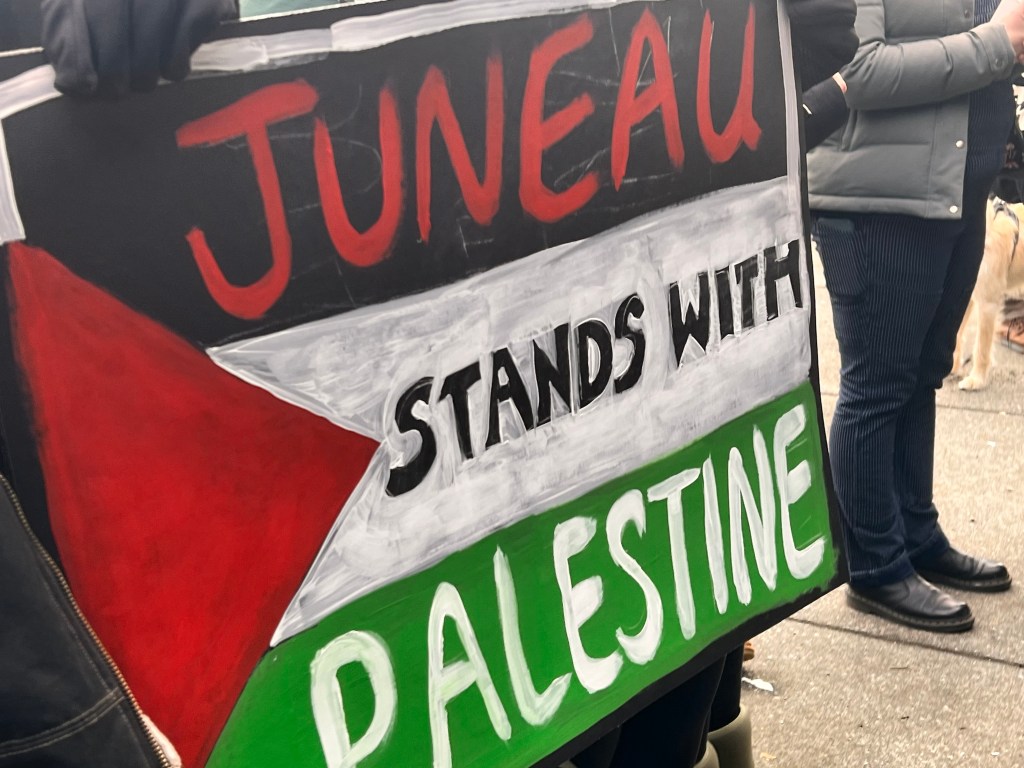
Juneau for Palestine (JFP), a local activist group, held a rally at the Alaska State Capitol on Mar. 18 to demand a ceasefire in Gaza. This was the second rally held by Juneau for Palestine, following a Mar. 4 testimony in which activists urged the Juneau Assembly to join cities like Chicago and Denver in their ceasefire calls.
The Assembly did not take up the resolution, which was proposed by Assembly member Christine Woll.
“I personally believe that we need a ceasefire,” Woll told the Assembly at that March 4 meeting. She said the Assembly has influence when it comes to swaying the federal government to take actions that could “change the course of this human rights tragedy.”
At that meeting, JFP organizer Sonia Kumar said, “As a member of this community, a community whose own Indigenous stewards faced a genocide at the hands of colonists, it’s been extremely hard to sit back and watch as people are shot while trying to get flour or make bread for their families.”
JFP organizer Harper Gunn compared the proposed ceasefire resolution to the Assembly’s failed 2022 resolution to sever Juneau’s ties with Vladivostok, following Russia’s invasion of Ukraine.
“My impression is that the assembly is resistant to put something forward that they feel might be controversial,” Gunn said, including a non-local, controversial issue like a ceasefire between Hamas and the Israelis.

Speaking to the Gaza resolution, Assembly member Alicia Hughes-Skandijs acknowledged that what’s happening in Gaza is “a real genocide.” But, she said, “As an Assembly, the more we can stay focused on nonpartisan local stuff the better for all of us.”
Later in an interview on KINY’s Action Line, Juneau City Manager Katie Koester said it was difficult for the Assembly to “interfere with and opine on international issues.”
“I think there’s a lot of empathy on the Assembly board for those issues,” Koester said, adding “you can’t really control your messaging once something is out there.”
Gunn said the Juneau for Palestine group disagreed with the Assembly’s reluctance to take a formal stand on a ceasefire resolution.
“While Juneau is a small community, and it is understandable that some members of the assembly are reluctant to rock the boat, we believe this undercuts and devalues the role that Juneau plays as one of the largest cities in Alaska, as the state capital of Alaska, and as a city recognized and known around the world,” Gunn said.
The group continues to meet with Assembly members to push for a ceasefire resolution, though nothing has been introduced yet, Gunn said. “We are urging the Assembly as a whole to stand by what is right and pass this resolution. “
A Brief History
Hamas, a Palestinian political and military group, launched a near-border surprise attack on Israel on Oct. 7. Israel reported that around 1,200 people were killed in that attack.
Since then, the Israeli Defense Force (IDF), led by Prime Minister Benjamin Netanyahu, has bombarded the Gaza strip with air strikes, launching a large-scale ground invasion on Oct. 27. Israel’s retaliation marks the most significant escalation of the broader Israeli-Palestinian conflict since the Yom Kippur war of 1973, according to The Guardian.
Throughout the bombings, Israel warned the people of Gaza to “evacuate” to escape the attacks. Rafah, the southernmost city in the Gaza strip, became a last refuge for many displaced civilians. On Feb. 11, Israel began bombing Rafah.
As the conflict continues to escalate, many claim there are no safe places in Gaza for civilians to go.
For Gazans, crossing the southern border into Egypt is notoriously difficult. In 2010, British Prime Minister David Cameron called Gaza an “open-air prison,” which has since become a common phrase to describe the region.

According to the Palestinian Ministry of Health in Ramallah, one in of every 100 people in Gaza has been killed since Oct. 7. The Ministry is the only official source on the Gaza death toll, since Israel’s blockade of the region prevents journalists from entering.
The United Nations International Children’s Emergency Fund, or UNICEF, estimates that nearly half of all people in Gaza are children.
America’s Support of Israel
In December, the UN General Assembly voted to to call for an immediate humanitarian ceasefire in Gaza, and the immediate, unconditional release of all hostages on both sides. The United States and Israel were among 10 nations that voted against the resolution, while 153 countries voted in favor of it, and 23 abstained.

The United States has supported Israel for decades. Israel is the largest cumulative recipient of U.S. military aid, receiving over $216 billion, according to the United States Agency for International Development (USAID).
After the Oct. 7 attack, President Joe Biden offered “all appropriate means of support to the Government and people of Israel” in a call to Prime Minister Netanyahu.
Pro-Palestine organizations across America, including Juneau for Palestine, say Israel’s actions constitute a genocide. A letter to state officials, signed by Juneau for Palestine, says, “Alaskans have had enough of our tax dollars being used in order to fund this genocide. We urge you to vote down any bills that send weapons to Israel for genocide and support bills that cut all aid to the Israeli military.”
Tens of thousands of people across America and the world have taken part in pro-Palestine protests, condemning the U.S. Government’s support of Israel and calling for an immediate ceasefire, an end to the blockades of Gaza and the West Bank, and an end to the Israeli occupation of Palestine.
Juneau for Palestine
Juneau for Palestine organized its first rally on Feb. 24, which saw the Marine Park gazebo packed with protesters demanding an immediate ceasefire. About 150 people attended.
“I know a lot of people feel defeated and powerless,” activist Nicole Church said at the rally. “Just remember we don’t fight fascists to win, we fight them because they are fascists. Israel has already lost in the war of public opinion, and with our collective solidarity and action, they will be defeated. A ceasefire will happen. Ceasefire now, defund Israel, free Palestine!”

According to the health ministry in Gaza, the death toll since the conflict began in October is nearly 30,000, similar to Juneau’s population.
Ernestine Shaankaláx̱t’ Hayes, Alaska writer laureate and retired University of Alaska Southeast professor, invited the crowd to imagine themselves as Gazans.
“What would I do? Where could I go? Where would we be safe?” Hayes asked. “Our homes would be rubble, our hospitals would be bombed, where would we take our wounded loved ones?”
Eshita Rahman, a Muslim Alaskan, has been passionate about Palestinian liberation since their high school years. They said since their parents survived a genocide, they feel connected to the fight for Palestinian liberation.
Several speakers and attendees of the rally made connections between the Israeli occupation of Palestine and the American colonization of Lingit Aani (Juneau.)
Rahman urged the community of Juneau to acknowledge that Palestinian lives are no less significant than American lives. They called for an end to American tax dollars “funding the violence against Palestinians”.
Arias Hoyle, a Juneau-based Lingít artist known as Air Jazz, closed the rally with a spoken-word poem.

“If you keep an eye on all of your young and your youth, they can be the ones to take you out of your current crisis because they’ll know all the right calls and they’ll live to see another day and make a difference,” he said. “That’s what we’re all here for.”

After the rally, Harper Gunn said it was clear that the people of Juneau stand with the Palestinian people. “I think the fact that so many people from all different cross-sections of the community came out to support, and to speak, and to play music, just shows where the community stands here,” she said.
Juneau for Palestine invites Juneauites to take action by joining the Facebook group “Juneau Demands Ceasefire,” following the Juneau for Palestine Instagram page, and signing a letter demanding Alaska’s congressional delegation make a public call for a ceasefire. The letter will be delivered to their Alaska and Washington, D.C. offices.
 WHALESONG
Leave a comment